If you have ever received an oil analysis report showing a value like 18/16/13 and were not sure whether it was good or bad, this article is for you. That number is the ISO 4406 cleanliness code, the standard way to express how many solid particles are present in a hydraulic fluid or lubricant.
Particle contamination is the leading cause of wear in hydraulic systems. Knowing how to read this code helps you decide when to filter, when to change the oil and when to track down a source of dirt before it damages pumps, valves or bearings.
What the ISO 4406 code measures
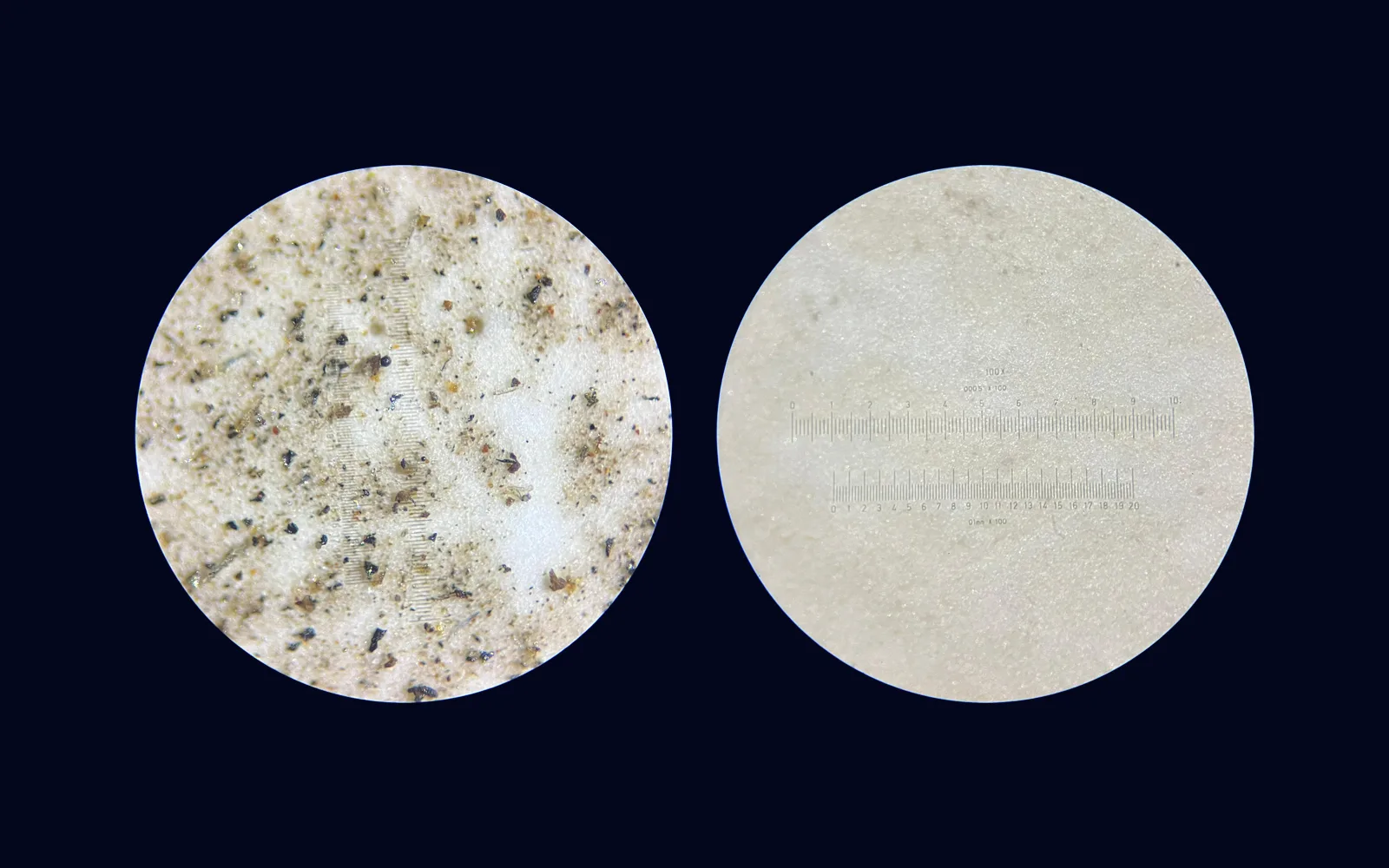
The laboratory counts the particles in 1 mL of oil and groups them into three sizes:
- First number: particles of 4 µm and larger.
- Second number: particles of 6 µm and larger.
- Third number: particles of 14 µm and larger.
Each number is not the particle count itself but a range code. This turns thousands of particles into a short value that is easy to compare between samples.
For reference, a human hair is 50 to 100 µm thick. The particles in this code are invisible to the naked eye, yet they are exactly the size that fits into pump and valve clearances.
How each number converts to particles
Each code stands for a range, and every step up roughly doubles the number of particles. Here is an excerpt of the table in the standard:
| Code | Particles per mL (more than) | Particles per mL (up to) |
|---|---|---|
| 21 | 10,000 | 20,000 |
| 20 | 5,000 | 10,000 |
| 19 | 2,500 | 5,000 |
| 18 | 1,300 | 2,500 |
| 17 | 640 | 1,300 |
| 16 | 320 | 640 |
| 15 | 160 | 320 |
| 14 | 80 | 160 |
| 13 | 40 | 80 |
| 12 | 20 | 40 |
| 11 | 10 | 20 |
Example: reading 18/16/13
Using the table above, a result of 18/16/13 means that every millilitre of oil contains:
- Between 1,300 and 2,500 particles of 4 µm or larger.
- Between 320 and 640 particles of 6 µm or larger.
- Between 40 and 80 particles of 14 µm or larger.
If the next sample comes back at 20/18/15, that is not a small change: two codes higher in every size means the oil holds about four times as many particles. That is why the trend matters more than a single value.
This short video explains the code in one minute (in Spanish, with on-screen numbers that are easy to follow):
What cleanliness level your equipment needs
There is no single correct value. The target depends on how sensitive the components are and on the operating pressure. As a general reference, targets like these are common:
| Component type | Indicative target |
|---|---|
| Servo and proportional valves | 16/14/11 or cleaner |
| High pressure piston pumps | 17/15/12 |
| Gear and vane pumps | 18/16/13 |
| Industrial gearboxes | 18/16/13 to 19/17/14 |
These values are indicative. Always confirm the target with the equipment manufacturer and adjust it to how critical the system is in your operation.
Something that surprises many people: new oil is not always clean. Drum oil often arrives with higher codes than a hydraulic system can tolerate, which is why filtering it before filling is recommended.
What to do if the code rises
A rising ISO 4406 code means dirt is getting in or particles are being generated inside the system. The usual steps are:
- Check the filters: saturation, an open bypass or an element with lower efficiency than specified.
- Check breathers and seals: they are the most common entry point for airborne dust.
- Compare with wear metals: if iron or copper rise at the same time, the particles may come from internal wear rather than from outside.
- Confirm the sampling: a sample taken from a dead leg or in a dirty bottle can produce a false code.
How we measure it at Tribo-Labs
At Tribo-Labs particle counting is part of the TRIBO 1 package, together with viscosity, TAN, ICP-OES spectrometry and FT-IR. That way you know not only how much contamination there is, but also where it may be coming from. All analyses are performed under ISO/IEC 17025:2017 with A2LA accreditation, and results are delivered in 48-72 h.