Every time two metal surfaces rub inside an engine, microscopic particles break off and stay suspended in the oil. ICP-OES spectrometry measures the concentration of those elements in parts per million (ppm), and each metal points to a family of components.
Knowing what each element means takes you from "iron is high" to "there is probably liner and ring wear from dust ingress". That is the difference between a number and a diagnosis.
The main wear metals
| Element | Usual source in an engine |
|---|---|
| Iron (Fe) | Cylinder liners, crankshaft, camshaft, gears, rings |
| Chromium (Cr) | Chrome plated piston rings, some liners |
| Aluminium (Al) | Pistons, aluminium bearings, housings, turbocharger |
| Copper (Cu) | Bronze bearings and bushings, oil cooler |
| Lead (Pb) | Bearing overlay |
| Tin (Sn) | Bearing overlay, bushings, piston coating |
| Nickel (Ni) | Valve guides, alloys in some components |
Contaminants that matter too
Some elements do not come from wear but from something that got into the oil:
- Silicon (Si): usually points to dust from a leak in the air intake or the air filter. Note that it can also come from antifoam additives or silicone sealants.
- Sodium (Na), potassium (K) and boron (B): when they rise together, they are a typical sign of a coolant leak. It is confirmed by detecting glycol with FT-IR.
The report also includes additive elements such as zinc, phosphorus, calcium, magnesium and molybdenum. They are not wear: they confirm the oil is the right one and show whether it was topped up with a different product.
Read the metals together
A single element rarely gives the full diagnosis. Patterns are far more useful:
- Rising silicon + iron + chromium + aluminium: dust entering through the intake and wearing rings, liners and pistons.
- Rising copper + lead + tin: bearing wear. Check oil pressure and possible lubrication problems.
- Sodium + potassium + boron with glycol: coolant leaking into the oil, for example through a gasket or a damaged cooler.
- High copper with no other metals, in a new or freshly rebuilt engine: this can be leaching from the oil cooler, which usually settles over time.
The trend matters more than the absolute value
There is no universal ppm limit for each metal. What is normal depends on the engine model, the duty cycle and the oil hours. That is why the most reliable approach is to compare each sample with previous ones from the same engine.
A sudden jump between two consecutive samples is usually more important than a high but stable value.
For the comparison to be valid, always record the oil hours and any top-ups. Oil with twice the hours naturally carries more metals.
A limitation worth knowing
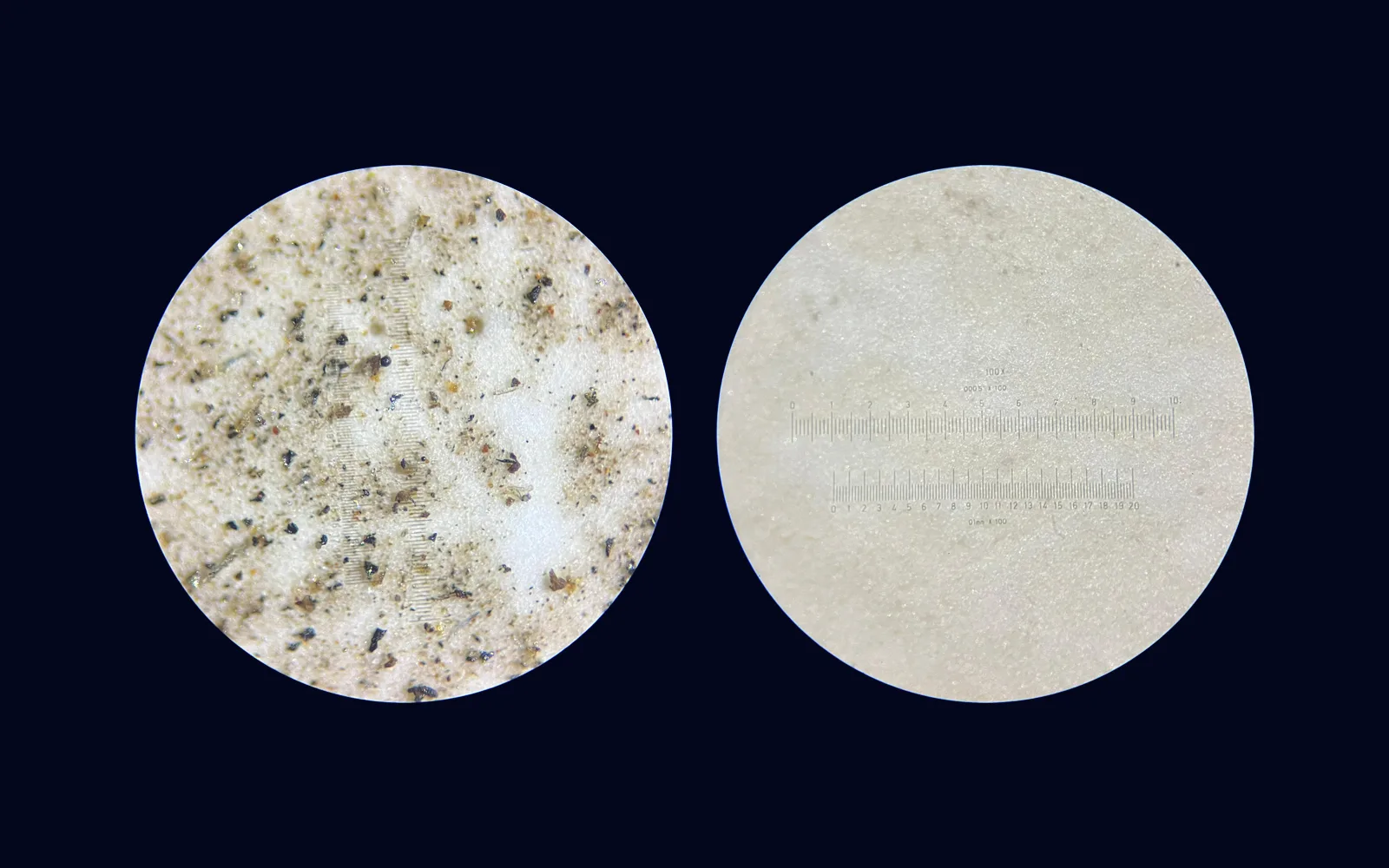
ICP-OES spectrometry detects small particles well, below roughly 10 µm. When wear is severe and produces larger particles, the ppm value may not reflect how serious it really is. In those cases it is complemented with techniques such as ferrography, which shows the shape and size of the particles.
Engine analysis at Tribo-Labs
The TRIBO 4 package combines ICP-OES for wear metals, contaminants and additives with FT-IR for soot, glycol, water, fuel dilution and oxidation, plus TBN, TAN, viscosity at 100 °C and fuel dilution by gas chromatography. All under ISO/IEC 17025:2017 with A2LA accreditation, with results in 48-72 h.